
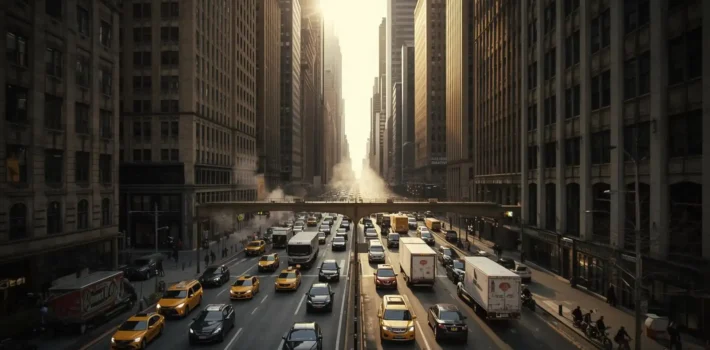
Why Midtown Manhattan Traffic Feels Different
Midtown Manhattan is one of the most traffic-saturated areas in the United States, and the congestion there is not simply the result of too many cars on the road. It is produced by the overlap of several distinct travel populations, all moving through the same corridors at the same time.
Office workers, hotel guests, tourists, delivery operations, ride-hailing vehicles, and event attendees all share the same streets. On most weekdays, those populations peak simultaneously during morning and evening commute windows, compressing movement across avenues and cross streets that were not designed for this volume.
What makes Midtown traffic genuinely different from other congested areas is how dramatically it changes by time of day. The same avenue that moves freely at 6 AM can be at a near standstill by 8:30 AM. A trip that takes 12 minutes at noon can take 45 minutes at 5:30 PM. Travel timing, in Midtown, matters far more than the mileage involved.
Why Midtown Experiences Heavy Traffic
No single cause is responsible for Midtown congestion. It is the result of several overlapping demand sources that are active throughout the day.
The corporate office concentration in Midtown is among the highest of any business district in the world. The area bounded roughly by 34th Street to the south and 59th Street to the north contains some of the highest employment density in the country. Hundreds of thousands of workers arrive each weekday morning and depart each evening, producing two predictable surge windows that shape the entire day’s traffic behavior.
Tourism adds a secondary layer. Times Square alone attracts an estimated 50 million visitors annually, and the concentration of hotels along Seventh Avenue, Broadway, and the adjacent side streets means a constant flow of taxi, rideshare, and car service pickups and drop-offs throughout the day. Luggage, unfamiliar navigation, and slow vehicle loading all contribute to delays that extend well beyond the immediate hotel block.
Delivery vehicles represent a third significant factor. Midtown’s density of restaurants, retailers, and office buildings generates an enormous volume of daily deliveries. Trucks double-parked during peak commercial hours reduce effective lane capacity on already narrow cross streets, and this effect is compounded during the hours when delivery windows overlap with commuter traffic.
Event venues add unpredictable but significant load on top of these baseline patterns. Madison Square Garden, the Javits Convention Center, Radio City Music Hall, Carnegie Hall, and dozens of Broadway theaters all draw large crowds. On event nights, the traffic pressure around Penn Station, 8th Avenue, and the Theater District extends well beyond normal evening patterns.
Major Midtown Areas That Experience Congestion
Midtown is not uniformly congested. Specific areas experience distinct pressure based on their function, the populations they serve, and the time of day.
| Area | Primary Traffic Pressure | Peak Windows |
|---|---|---|
| Times Square | Tourism volume and event activity | Midday through late evening, especially weekends |
| Penn Station area (31st to 34th Street) | Commuter arrivals and departures | 7 to 10 AM inbound, 4 to 7 PM outbound |
| Grand Central area (42nd Street corridor) | Office concentration, transit connections | Morning and evening commute windows |
| Midtown East (Park and Lexington avenues) | Corporate office district movement | Weekday commute peaks, lunch movement |
| Theater District (44th to 50th, 7th to 9th) | Evening show traffic and restaurant activity | 6 to 8 PM on show nights, post-show dispersal |
| Javits Convention Center corridor (34th to 38th, 11th to 12th) | Convention and trade show vehicle volume | Variable by event schedule |
Times Square behaves like a separate traffic system. Its pedestrian plazas push vehicle lanes to the edges of Broadway and 7th Avenue, and the concentration of ride-hailing pickups creates a near-permanent state of partial blockage. The area is most consistently difficult between noon and midnight, with weekend afternoons and evenings representing the least predictable conditions.
The Penn Station corridor is shaped by commuter rail and Amtrak schedules. The concentration of commuters on foot crossing 7th, 8th, and 9th Avenues between 31st and 34th Street creates one of the highest pedestrian-vehicle conflict zones in the city during peak hours. Vehicles traveling east-west on 34th Street during morning peak should expect significant delays regardless of starting point.
Midtown East along Park and Lexington Avenues is driven primarily by office arrivals and departures. The pattern there is more predictable than Times Square but still produces significant delays during the 8 to 9:30 AM and 5 to 6:30 PM windows. Grand Central’s proximity at 42nd Street compounds this, as surface traffic responds to train arrivals and departures throughout the day.
Midtown Traffic Pattern by Time Window
The table below represents typical conditions for vehicle movement within and approaching Midtown Manhattan. These are conservative estimates that reflect normal weekday patterns without major events or incidents.
| Time Window | Typical Conditions | Travel Predictability |
|---|---|---|
| 5 AM to 7 AM | Light traffic, streets largely clear | High |
| 7 AM to 10 AM | Heavy inbound movement, avenues slow | Lower |
| 10 AM to 2 PM | Moderate, active but manageable | Medium |
| 2 PM to 4 PM | Activity increasing, early-exit commuters beginning | Medium |
| 4 PM to 7 PM | Peak congestion across most of Midtown | Lower |
| 7 PM to 10 PM | Event and restaurant traffic, variable by night | Variable |
| 10 PM onward | Improving movement, more predictable conditions | Higher |
The 7 to 10 AM window is the most consistently difficult. Inbound vehicle volume from all directions, including the Lincoln Tunnel corridor to the west, the Midtown tunnels to the east, and surface streets from the south, converges simultaneously. Avenues serving as primary north-south routes, including 6th, 7th, 8th, and 10th Avenues, are most affected.
The 4 to 7 PM window is equally congested in reverse. Outbound flow toward the Lincoln Tunnel, the Queensboro Bridge, and the Queens-Midtown Tunnel creates a sustained bottleneck that can extend the tunnel approach time by 30 to 60 minutes beyond normal travel expectations.
The midday window from 10 AM to 2 PM represents the most workable conditions for discretionary travel. Traffic is present but generally moving. This window is often the most reliable for scheduled appointments, client visits, or transfers that can be timed flexibly.
Real NYC Congestion Data
Midtown’s congestion does not exist in isolation. It sits within a city-wide pattern that consistently ranks among the worst in the world.
According to the 2024 INRIX Global Traffic Scorecard, New York City and Chicago each recorded 102 hours lost per driver to traffic congestion in 2024, making them the most congested urban areas in the United States and among the worst globally. Those delays cost the average New York City driver $1,826 in lost time and productivity, with a city-wide total reaching $9.5 billion for the year.
The average downtown driving speed in New York City was recorded at only 13 miles per hour in 2024, according to INRIX data. Historically, traffic speeds recorded in Midtown by NYC DOT have been tracked as a long-term performance metric, with the area between 34th and 60th Streets serving as one of the primary measurement zones for city-wide congestion analysis.
| Traffic Data Metric | NYC Insight |
|---|---|
| Annual hours lost per driver (2024) | 102 hours (INRIX Global Traffic Scorecard) |
| Cost of lost time per driver | $1,826 per year |
| City-wide cost of congestion | $9.5 billion annually |
| Average downtown driving speed | 13 mph (2024 INRIX data) |
| U.S. congestion ranking | Most congested city (tied with Chicago) |
| Peak congestion windows | Weekday 7 to 10 AM and 4 to 7 PM |
| Most affected corridors | Midtown avenues, tunnel approaches, 34th to 57th Street zones |
It is also worth noting that NYC’s congestion pricing program, introduced in January 2025, has begun to show measurable effects on certain corridors within the zone below 60th Street. Early INRIX data following the program’s launch showed travel speed improvements in parts of the congestion pricing zone, with excessive delay at intersections such as Park Avenue and 57th Street dropping significantly. The long-term effect on overall Midtown travel times is still developing, and travelers are advised to monitor current conditions rather than rely on pre-2025 assumptions.
How Events Change Midtown Traffic
Baseline traffic patterns represent normal weekday conditions. Events layer an additional, often significant, demand on top of those baselines, and the effect can extend well beyond the immediate venue area.
Broadway shows follow a largely predictable schedule, with most evening performances beginning at 8 PM and curtain calls around 10 to 10:30 PM. The pre-show window from 7 to 7:45 PM produces a concentrated surge of vehicle arrivals along 44th to 50th Streets between 7th and 9th Avenues. Post-show dispersal between 10 and 11 PM creates a secondary congestion event in the same corridors.
Madison Square Garden events generate among the most significant venue-driven traffic impacts in Midtown. The Garden sits at 33rd Street and 8th Avenue, directly above Penn Station. Concerts, Knicks games, Rangers games, and major sporting events draw crowds of 18,000 to 20,000 people, and vehicle arrivals during the 90 minutes before an event start time saturate 7th, 8th, and 9th Avenues from 30th to 38th Street. For travelers using the Lincoln Tunnel corridor, whose Midtown exit is directly adjacent to this zone, MSG event nights should be treated as a materially different traffic scenario than a normal weekday evening.
The Javits Convention Center, located on 11th Avenue between 34th and 40th Streets, hosts major trade shows and conventions throughout the year. Large conventions can bring tens of thousands of attendees to the area over multiple days, generating sustained elevated traffic on the far west side of Midtown. This effect is particularly relevant for Lincoln Tunnel users, as the Javits sits within a half-mile of the tunnel exit.
Holiday periods represent a distinct traffic category. The weeks between Thanksgiving and New Year’s Day bring a significant increase in tourist volume to Midtown, concentrated around the Rockefeller Center tree, the Theater District, and 5th Avenue retail. Saturday afternoons and evenings during this period are among the most consistently congested windows of the entire year.
Why Business Travelers Need Different Planning
For leisure travelers, traffic variability is an inconvenience. For executives and business travelers, it is a scheduling risk with consequences that extend beyond the car.
Most business meetings are scheduled during the hours that overlap with Midtown’s peak congestion windows. A 9 AM meeting, a noon lunch, and a 5 PM debrief are all positioned within or directly adjacent to the most difficult traffic periods of the day. This is not a coincidence, it is simply the structure of the business day, and it means that business travelers face Midtown traffic at its worst on a routine basis.
The downstream consequences of delayed arrivals are not symmetric. Arriving 15 minutes early to a client meeting costs nothing. Arriving 15 minutes late introduces friction, communicates disorganization, and can affect the outcome of the interaction. For executives with back-to-back schedules, a 20-minute delay on one appointment can compress or eliminate the next.
Route predictability, in this context, becomes more important than shortest mileage. A slightly longer route that delivers a consistent 50-minute travel time is more valuable to a business traveler than a shorter route that delivers anywhere between 40 and 80 minutes depending on conditions. Reliability is the actual metric that matters, and it is one that most consumer navigation tools are not designed to optimize for.
Midtown Travel Planning Tips
These practices are applicable regardless of whether travel is by personal vehicle, ride-hailing service, or pre-scheduled car service.
Avoid peak commuter windows when the schedule allows. Departures that can be shifted by 60 to 90 minutes in either direction, arriving before 7:30 AM or after 10 AM, and departing before 3:30 PM or after 7 PM, will encounter materially different conditions than those timed directly within the commuter peaks.
Buffer time should be built around the destination, not just the departure point. Adding 30 minutes to a route estimate is only meaningful if the buffer accounts for both the approach to Midtown and movement within Midtown to the final address. A driver exiting the Lincoln Tunnel at 39th Street still faces 15 to 25 minutes of in-Midtown travel during peak hours to reach destinations on the east side of the avenues.
The event calendar should be checked before any evening trip into Midtown. Madison Square Garden, Broadway theaters, and major Javits events are all publicly listed. A quick check of the schedule before departure takes 90 seconds and can prevent an avoidable 40-minute delay.
Real-time traffic apps should be checked 20 to 30 minutes before departure, not at the moment of leaving. Conditions change quickly in Midtown, and early awareness of a developing bottleneck gives the option to adjust departure time or route selection.
Why Midtown Traffic Also Affects Airport Travel
Midtown congestion does not only affect trips whose final destination is within Manhattan. It also materially affects airport-bound travel that passes through or around Midtown corridors.
For travelers heading to JFK International Airport from New Jersey, the route typically crosses into Manhattan first and then travels east toward Queens. Depending on the tunnel used, the approach to Queens-bound routes, including the Queens-Midtown Tunnel, the 59th Street Bridge, and the FDR Drive toward the Belt Parkway, all pass through or adjacent to Midtown traffic corridors. A JFK-bound traveler departing Monmouth County at 7:30 AM on a weekday will encounter Lincoln Tunnel congestion, Midtown surface congestion, and Queensboro Bridge or tunnel congestion in sequence. Each segment can add 15 to 30 minutes to the overall journey.
LaGuardia Airport, located in northern Queens, is accessed most directly via the Queensboro Bridge (59th Street Bridge) or the Midtown Tunnel. Both of these routes originate within Midtown Manhattan. A delayed surface transit from the Lincoln Tunnel exit to the Queensboro Bridge during morning peak can add 20 to 40 minutes to an LGA-bound trip without any incident or unusual event occurring.
For executives traveling to airports through Midtown, the planning logic shifts. Travel time to the airport should be calculated from the departure point in New Jersey to the airport, with the Midtown segment treated as an independent variable. The Midtown leg is often the most difficult to predict and benefits most from pre-scheduled routing rather than app-driven navigation decisions made in real time.
Final Thoughts: Midtown Timing Matters More Than Distance
Midtown Manhattan traffic is not simply a function of how many vehicles are on the road. It is the product of overlapping demand from office workers, tourists, delivery operations, event venues, and a transit infrastructure that concentrates millions of daily movements through a narrow urban corridor.
For anyone traveling between New Jersey and Manhattan on a regular basis, that complexity has practical implications. The distance from Monmouth County to a Midtown office does not change. The time that distance takes can vary by 40 to 60 minutes in either direction depending on when the trip is made, which route is taken, and what is happening in Midtown that day.
Planning around that variability, rather than ignoring it, is what separates consistent arrival performance from frequent delays. Knowing which windows to avoid, which event calendars to check, and which corridors within Midtown behave most predictably for a given destination are all inputs to a smarter travel decision.
Travelers and executives who move regularly between New Jersey and Manhattan often benefit from transportation strategies built around actual traffic behavior rather than straight mileage. Scheduled New York City car and limousine service from NJ Luxury Rides is structured around this kind of destination-aware, timing-informed routing, applied consistently across every trip. For a broader look at how tunnel selection and route planning interact with Midtown timing, the guide on Lincoln Tunnel vs Holland Tunnel: Which Route Makes More Sense for NJ Travelers covers the approach in detail.