
Newark or JFK for Manhattan Business Travel?

For executives traveling to Manhattan, the choice between Newark Liberty International Airport Read More
Manhattan Business Travel Planning Guide for Corporate Executives
Why Business Travel in Manhattan Requires More Planning
Manhattan is not a difficult business destination because of its Read More
How Chauffeur Services Coordinate Multi Stop Itineraries

Multi stop travel requires more coordination than simple pickup and drop-off service. When schedules include several destinations in one continuous window, Read More
Corporate Travel Etiquette and Chauffeur Protocols
Corporate transportation operates at the intersection of timing, perception, and discipline. In business environments, transportation does not simply move Read More
How Businesses Use Chauffeur Services to Improve Productivity
Business travel quietly drains productivity in ways that rarely appear on reports. Time lost to traffic decisions, navigation stress, and fragmented schedules Read More
Hourly Car Service vs Point to Point for Corporate Travel
Corporate travel rarely follows a clean script. Meetings run long, priorities shift, and timing pressure builds throughout the day. Transportation choices Read More
Why Executives Prefer Black Car Services Over Car Rentals

The Transportation Decision Executives Actually Make
Car rental is the default assumption for business travel in many corporate contexts. A flight is booked, a rental is added, and the traveler navigates the destination city independently. For a regional sales call or a two-day conference at a suburban hotel, that arrangement is workable. For executives managing tight meeting schedules, client-facing arrivals, and back-to-back appointments across a city like Manhattan or a multi-stop day out of Newark, the rental model introduces a category of operational friction that professional black car service is specifically designed to remove.
The preference that many executives develop for black car service over rentals is not primarily about comfort or status. It is about time, predictability, and the downstream consequences of getting either right or wrong on a high-stakes travel day. This article explains the reasoning behind that preference in concrete terms, including where the cost-benefit calculation actually lands for executives whose time carries measurable value.
Executive Travel Is Not the Same as Personal Travel
Personal travel optimizes for flexibility and cost. Executive travel optimizes for reliability and outcome. Those are different objectives, and they lead to different transportation decisions.
An executive traveling from Monmouth County to a 9 AM Midtown Manhattan meeting is not making a trip. The trip is a precondition for a high-value interaction that has its own schedule, its own stakeholders, and its own consequences if it starts late or arrives disorganized. The transportation does not stand alone. It is the first link in a chain that includes a client relationship, a board presentation, or a negotiation that the executive has been preparing for.
According to corporate ground transportation data published in 2026, 73 percent of Fortune 500 companies now mandate black car service for C-suite travel, and 67 percent of corporate travel managers reported increasing their chauffeur service budgets in 2026. The primary drivers cited were duty of care compliance (78 percent), reliability, and schedule predictability. These are not preferences for luxury. They are operational decisions made by organizations that have calculated the cost of transportation failures at the executive level.
The Real Cost of Executive Time During Business Travel
The business case for black car service over rental becomes clearest when executive time is assigned a concrete value. A senior executive whose total compensation places their effective hourly value at $300 per hour is not just inconvenienced by a 90-minute rental counter delay, a parking search, or a navigation error in an unfamiliar city. Those losses represent $450 in organizational value that does not return.
The ROI calculation applied to executive ground transportation is the same one applied to private aviation: if an executive’s time is valued at $300 per hour, converting a two-hour round-trip commute from a driving task into focused work time recovers $600 in productive value, which typically exceeds the cost of the professional car service providing that conversion. At the C-suite level, where total compensation commonly exceeds $500,000 annually, the hourly value figure is higher and the productivity argument is proportionally stronger.
Schedule compression magnifies these effects further. When meetings follow one another tightly across a day, each unplanned delay does not simply consume its own time. It compresses every subsequent segment of the day, reducing preparation time before appointments, eliminating recovery time between them, and raising the cognitive load of the executive who is now managing logistics and business simultaneously.
Where Rentals Introduce Friction into Executive Travel
Rental vehicles introduce operational friction at multiple stages of the trip, and each friction point has a time cost that accumulates across the travel day.
| Rental Vehicle Friction Point | Typical Time Cost | Executive Impact |
|---|---|---|
| Counter queue and vehicle pickup | 15 to 45 minutes (varies by airport and peak period) | Delays departure from airport; compresses buffer before first meeting |
| Navigation and route decisions | Ongoing; 5 to 20 minutes of added cognitive load per unfamiliar route | Attention diverted from meeting preparation; decision fatigue before arrival |
| Parking in Midtown Manhattan or Newark | 10 to 25 minutes to locate and enter; $40 to $80 per day | Unplanned time loss; physical separation from entrance creates additional walk time |
| Vehicle return logistics | 15 to 30 minutes including routing to return facility | Requires early departure from final appointment or missed return window |
| Fuel management | 10 to 20 minutes for fill-up; premium charges if returned empty | Adds an administrative task to end of a high-intensity travel day |
| Unfamiliar vehicle operation | Variable; higher in unfamiliar markets | Increased cognitive load; reduced confidence in high-stakes arrival environments |
None of these friction points is individually catastrophic. Cumulatively, across a full travel day that includes a morning flight, two Midtown meetings, a cross-town transfer, and an evening Newark departure, they represent 60 to 120 minutes of avoidable time loss and a sustained background cognitive drain that affects the executive’s performance at every meeting on the agenda.
How Black Car Service Removes Operational Decisions
Black car service removes the operational decisions that rental travel requires and replaces them with a single point of accountability. The driver is confirmed before departure. The route is planned around the specific Manhattan destination and the departure window. The vehicle is positioned at the address before the executive exits the building. There is no counter queue, no parking decision, no navigation task, and no return logistics.
The removal of those decisions is not a convenience. It is a structural change in how the executive’s cognitive bandwidth is allocated during a travel day. An executive who enters a vehicle, reviews notes for 40 minutes during the Lincoln Tunnel corridor, and arrives at a Midtown office composed and prepared has a materially different experience than one who drove from Newark, circled the block twice looking for the parking garage, and arrived slightly late with the mental residue of a tense urban drive.
Flight monitoring is the element of black car service that most visibly demonstrates its operational advantage over rental for airport transfers. When a flight is delayed by 45 minutes, a pre-arranged driver adjusts automatically and is positioned at arrivals when the executive actually lands. A rental counter does not adjust. A parking structure does not hold space. An executive who lands at Newark Liberty after a delayed flight and has a black car driver confirmed through flight tracking is experiencing a fundamentally different logistics outcome than one managing the same delay while navigating to a rental counter.
Punctuality as Professional Currency
Punctuality functions differently in executive environments than it does in personal travel. Arriving 10 minutes late to a client meeting is not a neutral event. It communicates something about how the executive values the other party’s time, and it begins the interaction on a footing that the executive then has to recover from during the meeting itself.
Professional black car services operate on early arrival standards rather than on-time arrival assumptions. A driver targeting a 7:30 AM pickup for a 9 AM Midtown meeting is building in the buffer for the Lincoln Tunnel approach during the morning peak window, the in-city segment from 39th Street and 9th Avenue to the specific destination address, and the curb access delay that is predictable at major Midtown hotels and office buildings during morning hours. That buffer is not padding. It is route intelligence applied to a specific corridor at a specific time of day.
For executives traveling the NJ-to-Manhattan corridor regularly, the Lincoln Tunnel approach is the primary traffic variable. Since congestion pricing was introduced in January 2025, morning rush hour speeds through the Lincoln Tunnel have improved by 24.7 percent compared to the pre-pricing baseline, but the window between 7 and 9:30 AM still requires meaningful buffer, particularly for destinations on the east side of Midtown where in-city travel from the 9th Avenue tunnel exit adds 15 to 25 minutes under normal conditions. A professional driver who runs this corridor regularly has that knowledge built into every departure calculation. A rental driver does not.
Professional Image and the First Impression Economy
The first impression formed in a business interaction begins before the meeting starts. It begins in the parking garage, in the lobby, and in the demeanor of the person walking through the door. An executive who arrives in a professionally chauffeured black car, steps out at the building entrance, and enters the lobby composed and on schedule has already communicated something about their organization’s standards before a word has been spoken.
This is not a superficial observation. In client-facing travel, investor meetings, and board interactions, the environment surrounding the executive is read as a signal. A black car service does not guarantee a successful meeting. It removes a set of signals that work against the executive’s intended presentation and replaces them with signals that support it.
Productivity During Transit
Transit time in a black car is working time. In a rental vehicle, it is not. The difference is complete and structural: a person navigating an unfamiliar route in a rental vehicle cannot simultaneously review documents, conduct calls, or engage in the kind of sustained focus that meeting preparation requires. A passenger in a professional vehicle can do all of these things without exception.
For an executive making a 60 to 90 minute trip from Monmouth County to Midtown Manhattan, that transit segment represents a meaningful portion of the morning. Used for preparation, it extends the effective working day. Used for driving, it is simply time consumed by a task that another person could be performing on the executive’s behalf.
The vehicle environment matters beyond simply having a driver. A professional black car service provides a quiet, climate-controlled cabin with adequate space for document review, reliable cell connectivity for calls, and a driver who understands that the passenger’s work is the priority for the duration of the trip. That environment is not replicated in a rental vehicle regardless of how capable the driver is, because the driver and the passenger are the same person.
Risk Management and Duty of Care
Corporate travel policies increasingly treat ground transportation as a risk management decision rather than a cost decision. The concept of duty of care, the legal and ethical obligation organizations carry for employee safety during business travel, applies to ground transportation as directly as it applies to flight selection or hotel accommodation.
Black car services operate under commercial licensing, commercial insurance, and professional driver vetting requirements that exceed what rental vehicles and consumer ride-hailing platforms provide. Drivers are screened, vehicles are maintained to commercial standards, and the operating company carries accountability for the trip outcome in a way that a personal rental arrangement does not. According to the International SOS Annual Travel Risk Survey 2025, duty of care compliance was cited as the primary driver of the shift from ride-hailing to professional ground transportation by 78 percent of corporate travel managers surveyed.
Contingency coverage is a practical expression of that accountability. When a road incident, a tunnel closure, or a weather event disrupts the planned route, a professional black car service has a dispatcher monitoring conditions and a driver with the route knowledge to execute an alternative. A rental driver in an unfamiliar market has a navigation app and no backup. The asymmetry of those two outcomes matters more as the stakes of the meeting at the destination increase.
Performance in Unfamiliar Markets
The case for black car service over rental is strongest in markets where the executive is not a regular visitor. In an unfamiliar city, a rental vehicle removes the local knowledge advantage that experienced drivers provide while adding the cognitive load of learning road patterns, parking structures, and venue access logistics on the fly during a business trip.
For executives based in Monmouth County or the New Jersey Shore area who travel regularly to Manhattan, the NJ-to-Manhattan corridor has specific characteristics that reward local knowledge: tunnel selection by destination (Lincoln Tunnel for Midtown, Holland Tunnel for Lower Manhattan), the XBL bus lane’s effect on Lincoln Tunnel car capacity during 6 to 10 AM weekdays, congestion pricing zone boundaries, and curb access patterns at specific Midtown hotels and offices during peak hours. A driver who navigates that corridor daily applies that knowledge automatically. An executive driving a rental from Newark Liberty to a Park Avenue address at 8 AM is encountering each of those variables without prior context.
Black Car Service vs Rental vs Ride-Hailing: The Full Comparison
| Factor | Black Car Service | Car Rental | Ride-Hailing (Uber/Lyft) |
|---|---|---|---|
| Advance booking and confirmation | Confirmed; driver assigned before trip | Vehicle class reserved; specific car unknown | On-demand; no advance driver confirmation |
| Flight monitoring for airport transfers | Yes; pickup adjusts to actual landing time | Not applicable; executive manages own transfer | No; passenger must request after landing |
| Route planning by destination | Yes; tunnel and route selected before departure | Navigation app; reactive to real-time conditions only | Driver’s discretion; variable quality |
| Executive productivity during transit | Full; passenger can work throughout | None; executive is the driver | Partial; variable driver discretion and environment |
| Parking requirement | None; drop-off at destination entrance | Yes; $40 to $80 per day in Midtown Manhattan | None; drop-off at destination |
| Pricing predictability | Fixed rate quoted in advance | Base rate plus fuel, tolls, parking; variable total | Subject to surge pricing; unpredictable at peak periods |
| Driver vetting and accountability | Commercially licensed, vetted, insured | Executive is the driver | Platform-screened; variable; no company accountability |
| Privacy for calls and document review | High; professional driver understands discretion | None; executive cannot work while driving | Variable; shared environment with unknown driver |
| Contingency coverage | Dispatcher oversight; alternative routing available | Executive manages independently | No dispatch; passenger must rebook if driver cancels |
| Duty of care compliance | Commercial licensing and insurance standard | Personal responsibility | Platform liability; below commercial standard |
When Car Rentals Still Make Sense
Black car service is not the right answer for every business travel scenario. Rentals continue to make practical sense in specific contexts, and understanding those contexts prevents the case for professional transportation from becoming an overclaim.
| Travel Scenario | Better Choice | Reasoning |
|---|---|---|
| Extended stay with flexible, low-pressure schedule | Rental vehicle | Multi-day independence outweighs per-trip coordination benefit; no tight meeting schedule to protect |
| Remote location with limited professional car service availability | Rental vehicle | Professional services may not cover the area; rental is the only practical option |
| Budget-constrained travel with no client-facing component | Rental vehicle | When image and productivity during transit are not factors, cost optimization becomes the primary driver |
| Same-day Midtown Manhattan executive meeting, tight schedule | Black car service | Tunnel approach knowledge, flight monitoring, no parking delay, and in-transit productivity all apply directly |
| Airport transfer from Newark or JFK with early morning or peak departure | Black car service | Flight tracking, pre-positioned pickup, and tunnel buffer planning remove the most consequential risks |
| Multi-stop executive day across Manhattan districts | Black car service | Driver waits between appointments; no parking cost per stop; routing between districts handled without executive involvement |
How Executives Evaluate Transportation Partners
The evaluation of a professional transportation provider is not limited to the first trip. Executives and corporate travel managers who use black car services regularly evaluate providers based on performance patterns rather than individual experiences, and the criteria that matter most are consistent across organizations.
Reliability history is the primary criterion. A service that has performed consistently across a corridor, through a range of traffic conditions and schedule types, provides a track record that a single impressive trip does not. For executives making the NJ-to-Manhattan run multiple times per month, consistency is the value being purchased, not novelty.
Driver quality and operational discipline matter more than vehicle branding. A professionally maintained black sedan operated by a driver who knows the Lincoln Tunnel corridor, monitors flights, and communicates proactively about conditions delivers more executive value than a premium vehicle operated by a driver who is reactive and unfamiliar with the route.
Communication structure is the third evaluation criterion. A provider that confirms bookings, provides driver details in advance, updates on arrival status, and communicates when conditions require a plan change operates at a professional standard that is immediately distinguishable from providers who manage bookings reactively. For executives whose assistants or corporate travel teams are managing the booking, that communication structure is also what allows the transportation to operate without consuming the executive’s own attention.
Final Thoughts: Transportation as a Performance Input
The preference executives develop for black car service over car rentals is grounded in a straightforward operational logic. Rental vehicles require the executive to perform a set of driving, navigation, and parking tasks that consume time, attention, and cognitive capacity that would otherwise be directed at the business of the day. Professional black car service removes those tasks entirely and replaces them with a controlled, productive transit environment managed by a driver whose sole responsibility is the trip.
For executives traveling the New Jersey to Manhattan corridor, where tunnel approach conditions, congestion pricing zone logistics, and in-city routing all reward local knowledge, that value is specific and measurable. The difference between an executive who arrives at a Midtown meeting composed, prepared, and on schedule after a productive 70-minute transit from Monmouth County, and one who arrives having navigated the Lincoln Tunnel Helix and searched for parking for 20 minutes, is not a matter of preference. It is a performance difference with professional consequences.
NJ Luxury Rides provides black car service and corporate transportation services across Monmouth County, Ocean County, Manhattan, and regional airports including Newark Liberty, JFK, and LaGuardia. For companies with regular executive travel volume, business transportation plans are available to consolidate scheduling and billing across multiple travelers. For a broader look at how Manhattan traffic patterns, tunnel routing, and airport selection interact with executive travel planning, the Manhattan Business Travel Planning Guide for Corporate Executives covers the full framework.
Things You Must Know About Corporate Transportation in New Jersey
Corporate travel requires precision, professionalism, and a level of comfort that supports productivity and confidence. Whether a business traveler is heading to Read More
Corporate Transportation Etiquette
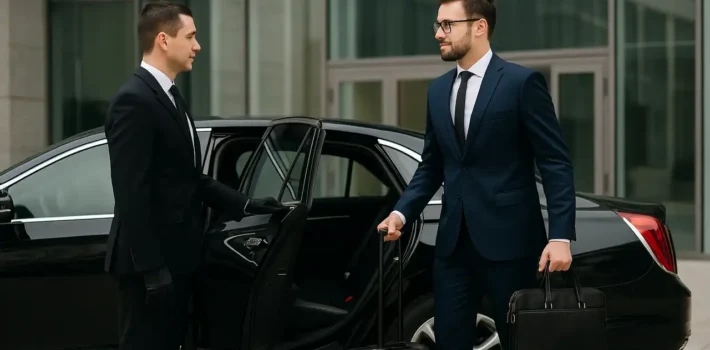
If you’ve ever had to host a client flying into Newark or JFK for an important meeting, you know the ride from the airport sets the tone for everything that follows. Read More