
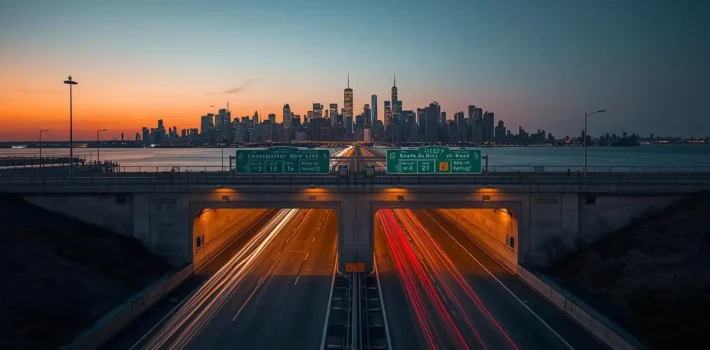
If you are driving from New Jersey to Manhattan, you will eventually face this question. And the honest answer is that neither tunnel is universally faster or better.
The Lincoln Tunnel and the Holland Tunnel both cross the Hudson River and both deliver you into Manhattan – but they do not deliver you to the same Manhattan. That distinction matters far more than which tunnel happens to be shorter or less congested on a given morning.
As a general principle: the Lincoln Tunnel is the practical choice for Midtown Manhattan destinations – offices in the 30s, 40s, and 50s, Times Square, Penn Station, the Javits Center, and most of the central business corridor. The Holland Tunnel is the natural entry point for Lower Manhattan – the Financial District, Tribeca, SoHo, the West Village, and Canal Street.
Choose the tunnel based on where you are going, not out of habit. That single shift in thinking will save you time, in-city driving, and unnecessary stress on most trips.
Where Each Tunnel Actually Leads
Understanding the tunnel endpoints removes a lot of guesswork. Each tunnel is essentially a fixed corridor – once you commit to it on the New Jersey side, your Manhattan entry point is set.
| Tunnel | NJ Entry Point | Manhattan Exit | Primary Destination Access | Common Use Cases |
|---|---|---|---|---|
| Lincoln Tunnel | Weehawken, NJ (via Route 495 / the Helix) | West 39th Street, Midtown | Midtown Manhattan | Corporate offices, Times Square, Penn Station, Hotel corridor, Javits Center |
| Holland Tunnel | Jersey City, NJ (via Route 1&9 / Route 139) | Canal Street, Lower Manhattan | Downtown and Lower Manhattan | Financial District, Tribeca, SoHo, West Village, Battery Park |
The Lincoln Tunnel exits at 39th Street between 9th and 10th Avenues – you are immediately in the heart of Midtown’s west side, a short drive or walk from virtually every major Midtown destination. The Holland Tunnel deposits you at Canal Street, putting Tribeca, the Financial District, and lower Manhattan just minutes away.
The problem is not knowing this – it is not applying it. Many New Jersey commuters default to one tunnel regardless of destination, then spend unnecessary time driving across or up and down Manhattan to reach their final stop. Let the destination make the decision for you.
Tunnel Infrastructure: The Facts
Both tunnels are operated by the Port Authority of New York and New Jersey and represent two of the most critical pieces of infrastructure in the Northeast corridor.
| Feature | Lincoln Tunnel | Holland Tunnel |
|---|---|---|
| Year first opened | 1937 | 1927 |
| Number of tubes | Three (north, center, south) | Two (eastbound and westbound) |
| Connection | Weehawken, NJ → Midtown Manhattan | Jersey City, NJ → Lower Manhattan (Canal Street) |
| Approximate length | ~1.5 miles (center tube: 8,216 ft) | ~1.6 miles |
| Approximate daily traffic | ~113,000 vehicles (as of 2016 data) | ~100,000 vehicles |
| Notable feature | Exclusive Bus Lane (XBL) during AM peak | World’s first mechanically ventilated tunnel |
| Tolls | Collected eastbound (NJ → NY) only | Collected eastbound (NJ → NY) only |
Lincoln Tunnel: The tunnel’s three tubes – north, center, and south – provide six total traffic lanes. The center tube has reversible lanes that allow traffic to flow inbound during morning hours and outbound during afternoon and evening commute times. The northern tube carries westbound traffic, while the southern tube carries eastbound traffic. This reversible lane system is a deliberate capacity management tool – but it does not prevent congestion during peak windows.
One noteworthy feature is the Exclusive Bus Lane (XBL). The XBL runs on weekday mornings from 6:00 to 10:00 AM. About 1,850 buses and 70,000 people use it each weekday morning. This means a meaningful portion of the Lincoln Tunnel’s peak-hour capacity is dedicated to bus transit, which affects how quickly car traffic moves through the remaining lanes during that window.
Holland Tunnel: The Holland Tunnel connects Hudson Square and Lower Manhattan in New York City to Jersey City, New Jersey, and carries Interstate 78. It is the older of the two tunnels, first opened in 1927, and holds the distinction of being the world’s first mechanically ventilated vehicular tunnel. Its two-tube configuration – eastbound and westbound – handles approximately 100,000 vehicles per day, making it one of the busiest tunnels in the United States.
Travel Time Comparison by Time Window
Travel times through either tunnel vary significantly based on when you travel. The table below reflects general conditions for vehicles approaching from New Jersey – not the in-tunnel transit time, which is minimal, but the full approach and exit experience.
| Time Window | Lincoln Tunnel Conditions | Holland Tunnel Conditions |
|---|---|---|
| 12 AM – 5 AM | Light traffic, fast approach | Light traffic, fast approach |
| 6 AM – 9 AM | Heavy inbound; XBL reduces car lanes | Moderate to heavy; manageable vs. Lincoln |
| 10 AM – 2 PM | Moderate; generally predictable | Moderate; generally predictable |
| 3 PM – 7 PM | Heavy outbound; helix backs up significantly | Heavy congestion; I-78/Route 139 corridor slows |
| 8 PM – 11 PM | Improving; variable based on events | Improving; medium-to-high predictability |
During the morning peak (6–9 AM), the Lincoln Tunnel’s approach – particularly the Helix, the elevated spiral roadway on the New Jersey side – is one of the most consistently congested segments in the region. The combination of high vehicle volume and the XBL bus lane reducing available car lanes creates a compounding bottleneck. If your destination is Midtown and you cannot avoid this window, plan for at least 20 to 40 additional minutes on the approach alone.
During evening outbound hours (3–7 PM), both tunnels perform poorly. The Lincoln Tunnel’s westbound flow through the center reversible tube helps modestly, but surface congestion leaving Midtown slows entry to the tunnel approaches significantly. The Holland Tunnel’s outbound approach through Jersey City can also stack well back during the same window.
These are conservative estimates. A major event at Madison Square Garden, a concert at the Barclays Center, or any incident inside either tunnel can shift these windows unpredictably.
How Destination Changes the Best Route
This is the most practical section for any NJ traveler to internalize. Raw distance and tunnel names matter far less than where you are going once you cross the river.
For Midtown Manhattan Destinations – Use the Lincoln Tunnel
Midtown Manhattan runs roughly from 34th Street to 59th Street. If your destination falls in this band – or anywhere in the central spine from 8th Avenue to Lexington Avenue – the Lincoln Tunnel is the correct approach. Coming out at 39th Street and 9th Avenue, you are already in Midtown’s core. Common destinations served well by this entry point include corporate offices in the 40s and 50s (Avenue of the Americas, Park Avenue, Lexington Avenue), Times Square and the Theater District, Penn Station and the adjacent hotel corridor, the Javits Convention Center, and Rockefeller Center and the 5th Avenue retail corridor.
Driving in via the Holland Tunnel for these destinations adds significant in-city distance – you would need to travel north through lower and mid Manhattan to reach the same endpoints.
For Lower Manhattan Destinations – Use the Holland Tunnel
Lower Manhattan sits south of Chambers Street, with the Financial District, Battery Park, and the World Trade Center area at its southern tip. SoHo, Tribeca, and the West Village occupy the lower-mid section of Manhattan below 14th Street. For any destination in this zone, the Holland Tunnel is the practical choice. Emerging at Canal Street, you are immediately adjacent to the Financial District and Wall Street corridor, Tribeca and Hudson Square, SoHo and Nolita, the West Village and Greenwich Village, and the Lower East Side with a short drive east on Canal.
Routing through the Lincoln Tunnel to reach these destinations means driving south through Midtown and potentially through Times Square or the Garment District – adding 20 to 40 minutes under normal weekday conditions, and considerably more during peak hours.
The Rule: Destination First, Tunnel Second
A helpful heuristic: if your destination is north of 23rd Street, lean toward Lincoln. If it is south of 14th Street, lean toward Holland. For the band in between – Chelsea, the Flatiron District, Union Square, the West Village – evaluate based on current conditions and which approach feels less burdened that day.
Real Traffic and Congestion Context
The tunnel decision does not happen in isolation. Manhattan sits within the broader reality of one of the most congested urban areas in the world.
According to the 2024 INRIX Global Traffic Scorecard, New York City drivers lost 102 hours annually to traffic congestion – more than $1,800 in wasted time per driver per year. New York ranked as the second most congested urban area in the United States, tied with Chicago.
Both tunnels feed directly into the traffic patterns that drive those numbers. The congestion is not random – it follows predictable patterns that tunnel-aware travelers can plan around.
| Traffic Variable | Impact on Tunnel Conditions |
|---|---|
| Weekday morning commute (6–9 AM) | Heaviest inbound pressure; Lincoln Tunnel approach most affected |
| Weekday evening commute (4–7 PM) | Heavy outbound flow; both tunnels back up significantly |
| Special events (MSG, concerts, conventions) | Can extend congestion windows by 1–2 hours beyond normal |
| Construction activity | Tube closures create significant ripple effects – check Port Authority alerts before travel |
| Weekend midday | Lighter commuter traffic but increased leisure travel; conditions more variable than weekday midday |
| Late night / early morning | Most predictable conditions; both tunnels operate near capacity ceiling without actually reaching it |
One additional factor unique to the Lincoln Tunnel: the Port Authority periodically conducts maintenance and rehabilitation work on individual tubes, requiring temporary closures or lane reductions. The Holland Tunnel’s westbound tube was closed during late nights between February 2023 and late 2025 for repair work. Planned construction can dramatically alter normal congestion patterns, and travelers who check Port Authority communications before departure avoid unpleasant surprises.
Why Tunnel Choice Changes Airport Travel Too
The Lincoln and Holland Tunnels are not just relevant for point-to-point Manhattan trips. Anyone traveling through Manhattan for airport connections needs to understand how tunnel selection interacts with route logic.
Routes toward JFK International Airport
JFK sits in Queens, accessible via the Queens-Midtown Tunnel or the Brooklyn-Queens Expressway through Brooklyn. From New Jersey, traveling to JFK typically means crossing into Manhattan first via either the Lincoln or Holland Tunnel, then heading east. The Lincoln Tunnel routes you into Midtown, where you can pick up the Queens-Midtown Tunnel or FDR Drive south toward the Belt Parkway to JFK. The Holland Tunnel approach through Lower Manhattan allows access via the Brooklyn Bridge or Battery Tunnel toward the BQE, which also connects to JFK. Neither route is significantly faster than the other for JFK – both add the in-city travel segment on top of the tunnel approach.
Routes toward LaGuardia Airport
LaGuardia is in northern Queens, making the Midtown approach via Lincoln Tunnel the more natural starting point. From the Lincoln Tunnel exit at 39th Street, you can reach the Queensboro Bridge (59th Street Bridge) and connect to the Grand Central Parkway toward LaGuardia. This adds roughly 30 to 45 minutes from the tunnel exit under moderate traffic conditions – more during weekday peak hours when the approaches to the Queensboro Bridge can also stack.
Manhattan Pickups and Drop-offs
For car service and limousine providers, the tunnel decision is built into the itinerary at the planning stage. A driver heading into Midtown for a hotel pickup does not choose their tunnel on the fly – it is determined by the pickup address before the trip begins. This is one of the structural advantages of pre-planned car service over self-navigation: route decisions are made with destination context baked in, not reactively once you are already on the road.
Practical Travel Planning Tips
Regardless of which tunnel your route calls for, these habits separate travelers who consistently arrive on time from those who consistently cut it close.
Match the tunnel to the destination before you leave, not after. Looking up your Manhattan destination address takes 30 seconds. Knowing whether you are heading to 47th Street or to Wall Street changes every subsequent decision – which road to take, which lane to be in, how much time to build in.
Check tunnel conditions 30 minutes before departure. Both the Waze and Google Maps apps update in real time for tunnel approach congestion. The Port Authority also publishes traffic alerts for both crossings. A five-minute check before you leave the driveway tells you whether normal conditions apply or whether something has shifted the pattern.
Add extra time on weekdays, particularly for the 6 to 9 AM and 4 to 7 PM windows. If you cannot move your departure time to avoid these windows, add at least 30 to 45 minutes to your expected travel time. Treat it as a floor, not a ceiling – conditions during peak windows are variable enough that the extra buffer earns itself back on most trips.
Watch for event-driven congestion. Madison Square Garden sits directly adjacent to the Lincoln Tunnel’s Midtown exit. Concert nights, Knicks and Rangers games, and major conventions at the Javits Center push congestion patterns well beyond their normal range. Check the event calendar before any evening trip through the Lincoln Tunnel corridor.
Plan for construction-related lane reductions. The Port Authority conducts ongoing rehabilitation work on both tunnels. Tube closures during late-night maintenance windows are announced in advance and can affect travelers who assume off-peak travel will be congestion-free.
Executive and Business Travel Considerations
For most leisure travelers, traffic variability is an inconvenience. For executives and business travelers, it is a scheduling risk.
A meeting at 10 AM in Midtown has a fixed start time. An 8 AM departure from Monmouth County under normal conditions leaves enough buffer. An 8 AM departure into unexpected Lincoln Tunnel congestion during a morning where an incident has closed one tube does not. The downstream consequences – a late arrival, an anxious client, a disrupted agenda – compound quickly.
Business travelers who understand that Midtown trips require Lincoln Tunnel routing and Lower Manhattan trips call for Holland Tunnel routing are already making smarter decisions than the majority of commuters. But the next level of reliability is removing the routing decision from the traveler entirely.
Executives and corporate travelers who use pre-scheduled car service are not just buying convenience – they are buying route intelligence. A driver who runs the Monmouth County to Manhattan corridor regularly knows current tunnel conditions, has a routing contingency if conditions shift during travel, and has already mapped the most direct path to your specific address. That is what planned transportation delivers beyond comfort.
Final Thoughts: Destination Beats Distance
The Lincoln Tunnel versus Holland Tunnel question is answered correctly almost every time by asking one prior question: where in Manhattan am I going?
The two tunnels are not interchangeable. They serve different geographies of the same borough, and choosing the wrong one adds unnecessary distance, in-city driving time, and exposure to some of Manhattan’s densest surface congestion.
Beyond the routing decision itself, the larger point holds: Manhattan traffic patterns shift constantly. The best drivers – professional or otherwise – treat tunnel selection as a planning decision made before departure, not a navigation decision made in the moment. Conditions can change between when you set out from New Jersey and when you reach the tunnel approach. Real-time awareness, combined with destination-aware routing, closes most of the gap.
Travelers and executives moving regularly between New Jersey and Manhattan often rely on planned routing strategies rather than default navigation suggestions – because what the app recommends in the moment does not always account for the full picture of where you are going, what time your meeting starts, and what is happening on the ground at both tunnel approaches simultaneously.
NJ Luxury Rides provides scheduled car and limousine service across the New Jersey to Manhattan corridor, including routes built around both Lincoln and Holland Tunnel approaches depending on destination. Whether your trip is to Midtown or Lower Manhattan, the routing is handled before the trip begins. Learn more about Monmouth County limousine service or read our guide on the best way to travel from Monmouth County to Manhattan for a fuller picture of how these routes connect.