How to Plan Transportation for Weddings in New Jersey
Wedding transportation shapes more than arrival times. It shapes the emotional flow of the day. In New Jersey, where venues range from shore estates Read More
How to Choose a Wedding Limo in New Jersey: Complete Transportation Planning Guide
Choosing wedding transportation is about much more than finding a beautiful vehicle. The right transportation plan needs to move the right people between the right locations at the right times, while leaving enough flexibility for photographs, traffic, venue access, and the small schedule changes that happen during almost every wedding.
For couples planning a wedding in New Jersey, those details become especially important. A summer celebration at the Jersey Shore can involve very different traffic and vehicle-access considerations from a ballroom wedding in North Jersey. A ceremony and reception at separate venues may require several coordinated trips, while a wedding with a hotel block may need transportation for the couple, wedding party, parents, and guests.
The best approach is therefore to plan the transportation system first and choose the vehicle second.
How Do You Choose the Right Wedding Limo?
Choose your wedding limo by considering following questions
- Who needs transportation?
- How many passengers will travel together?
- Where they need to go?
- How much time the itinerary allows?
- And which vehicle can comfortably accommodate everyone?
Then verify that the wedding transportation provider can handle the complete itinerary, venue access requirements, waiting time, schedule changes, and any special passenger needs.
Do not select a wedding vehicle based on appearance or maximum passenger capacity alone. A vehicle that technically accommodates a certain number of passengers may feel considerably tighter once you account for a wedding gown, formalwear, bouquets, personal belongings, and the space passengers need to enter and exit comfortably.
For a New Jersey wedding, couples should also consider traffic patterns, seasonality, venue locations, commercial transportation credentials, chauffeur requirements, and contingency planning before confirming a reservation.
Start With Your Wedding Transportation Plan, Not the Vehicle
It is easy to start by looking at photographs of luxury SUVs, sedans, Sprinter vans, and limousines. That is the enjoyable part of wedding transportation planning, but it should not be the first decision.
Start with the people and the itinerary.
Determine who needs transportation and where everyone will be at each stage of the wedding day. The couple may begin at separate locations. The wedding party may leave from a hotel. Parents might need their own transportation. Photographs could take place somewhere between the ceremony and reception, and everyone may need another transportation plan when the reception ends.
A useful first step is writing down every location in chronological order:
Getting-ready location → first look → ceremony → photography location → reception → hotel or final destination
Once you understand that sequence, you can determine which passengers need to move between each point. That gives you a much clearer picture of how many vehicles you need and what type of vehicle makes sense.
Map the Entire Wedding-Day Transportation Timeline
Wedding transportation should work as part of the overall wedding timeline rather than as a separate reservation.
| Wedding Stage | Transportation Question to Answer |
| Getting ready | Who needs transportation from the hotel, home, or preparation venue? |
| First look | Does the couple or wedding party need to travel to another location? |
| Ceremony | When must the couple, wedding party, and immediate family arrive? |
| Photography | Will photographs take place somewhere other than the ceremony venue? |
| Reception | Who needs transportation from the ceremony to the reception? |
| End of reception | Does the couple need a dedicated departure vehicle? |
| Hotel | Do family members or guests need transportation back to accommodations? |
This process often reveals transportation requirements that couples overlook when they initially request a quote.
For example, a couple may think they need a single vehicle from the hotel to the ceremony. Once they map the day, they discover that the wedding party needs transportation to the ceremony, then to a photography location, then to the reception, while the couple wants a private vehicle after the reception.
That is a transportation plan, not simply a limousine reservation.
Decide Who Actually Needs Wedding Transportation
Not everyone needs to travel together, and separating passengers into groups often makes the itinerary easier to manage.
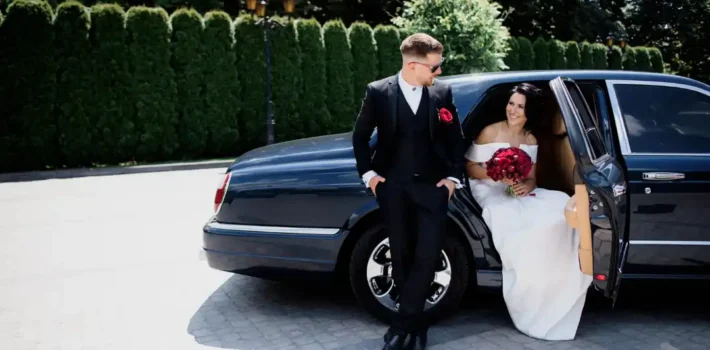
The couple may want private transportation at certain stages of the day, particularly after the ceremony or at the end of the reception. A sedan or luxury SUV can provide a quieter environment while still giving the couple enough room for formal attire.
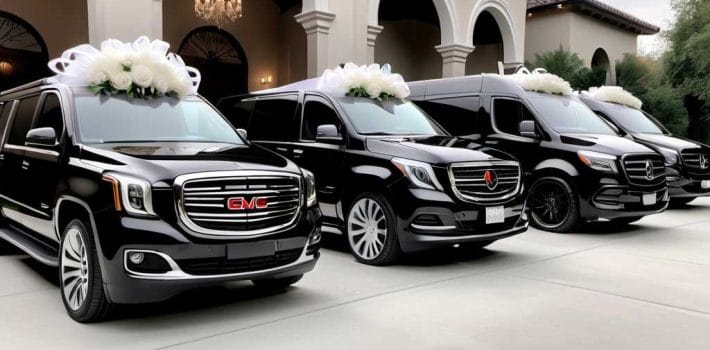
The wedding party usually benefits from staying together. A larger vehicle such as a Mercedes Sprinter can reduce the risk of several cars arriving at different times and makes it easier to move bridesmaids, groomsmen, and other members of the wedding party between locations.
Parents and immediate family may require separate planning, particularly if elderly family members need easier vehicle access or should arrive before the larger group.
Guests create a different transportation challenge. If many guests are staying at the same hotel, group transportation may make more sense than expecting everyone to arrange separate rides, especially when parking is limited or the reception includes alcohol.
Thinking about these groups individually helps determine whether your wedding requires one vehicle, several vehicles, or a coordinated transportation schedule.
Choose the Right Vehicle for Your Wedding
Once you know who is traveling together, you can start matching vehicles to each part of the itinerary.
| Vehicle Type | Best Suited For | Main Advantage | Planning Consideration |
| Luxury sedan | Couple or individual VIP | Privacy and comfort | Limited room for larger groups |
| Executive SUV | Couple or small family group | More passenger and personal-item space | Confirm practical capacity with formal attire |
| Mercedes Sprinter | Wedding party or larger group | Keeps passengers together | Confirm venue loading and staging space |
| Stretch limousine | Traditional wedding experience | Group atmosphere and classic presentation | Verify exact vehicle and comfortable capacity |
The important word here is comfortable.
A vehicle’s maximum rated capacity should not automatically become your wedding passenger count. Formal clothing changes the practical amount of space passengers need.
Do Not Choose a Wedding Vehicle by Maximum Capacity Alone
Imagine a vehicle that can technically seat a certain number of passengers. That figure does not account for a large wedding gown, bouquets, formal jackets, handbags, photography items, or passengers who may need additional space getting in and out.
A group that fits comfortably when wearing everyday clothing can feel very different on a wedding day.
Ask the transportation company for the comfortable passenger capacity for your specific use case, not simply the maximum seating capacity.
Also consider how passengers will enter and exit. Vehicle height, door configuration, steps, and interior space can matter for someone wearing a long gown or for older family members with limited mobility.
The correct vehicle should fit the people and circumstances, not merely satisfy a number on a specification sheet.
Build Realistic Buffer Time Into Your Wedding Schedule
Wedding schedules rarely unfold to the minute.
Hair and makeup can run late. A photographer may ask for another set of photographs. Guests can take longer than expected to leave the ceremony. The wedding party may need time to organize itself before boarding. Traffic can change quickly, and venue entrances sometimes become crowded when several vendors and vehicles arrive simultaneously.
Transportation planning should account for those realities.
| Possible Delay | Why a Buffer Helps |
| Boarding the wedding party | Formalwear and large groups can take longer to load |
| Photography | Photo sessions frequently involve multiple locations or additional shots |
| Traffic | Road conditions can change after the original itinerary is created |
| Venue arrival | Valet operations and guest traffic can slow vehicle access |
| Ceremony ending | Guests may gather around exits and transportation areas |
| Schedule changes | A buffer prevents one small delay from affecting every later trip |
A professional transportation schedule should therefore work backward from the time passengers must arrive, rather than assuming they can leave at the last possible moment.
If the ceremony begins at a specific time, the transportation plan should account for travel, unloading, walking into the venue, wedding-party organization, and any required preparation before the ceremony starts.
How New Jersey Traffic Changes Wedding Transportation Planning
New Jersey weddings present different transportation challenges depending on location and season.
A summer wedding near the Jersey Shore may encounter beach traffic, weekend visitors, local events, and heavier travel around popular coastal communities. Weddings throughout Monmouth County can involve routes connecting residential neighborhoods, hotels, waterfront venues, country clubs, and reception facilities across different towns.
The same applies throughout Ocean County, where summer traffic patterns can make a route behave differently from the same trip during the quieter months.
Weddings closer to New York City introduce another layer of complexity. Tunnel approaches, major highways, commuter traffic, construction, and Manhattan-bound travel can affect schedules even when the wedding itself takes place in New Jersey.
This is why a distance that looks short on a map does not always translate into a predictable wedding-day travel time.
Couples should give their transportation provider every address early enough for the company to evaluate the complete itinerary rather than treating each ride independently.
Plan the Ceremony, Reception, Hotel, and Photo Locations Together
Multi-location weddings require more careful coordination than weddings where everything happens at one property.
Consider this example:
Hotel → first-look location → ceremony → waterfront photographs → reception → hotel
Every additional stop introduces another timing dependency.
If the first look runs 15 minutes late, that delay can affect the ceremony arrival. If photography after the ceremony takes longer than planned, it can affect the reception entrance. If the wedding party uses multiple independent vehicles, one delayed car can hold up the entire group.
Keeping key passengers together can simplify these transitions.
Couples should provide their transportation company with the complete itinerary, including exact addresses, desired arrival times, passenger groups, photography stops, hotel details, and any special instructions from the wedding planner or venue.
Check Venue Access Before the Wedding Day
The route to a venue is only part of the transportation problem. The vehicle also needs somewhere appropriate to arrive, load passengers, unload passengers, wait, or stage.
Ask the venue whether it has:
- A designated limousine or shuttle entrance
- A separate valet entrance
- A loading area for larger vehicles
- Restrictions on where vehicles can wait
- Narrow entrances or driveways
- Height or size restrictions
- A preferred location for end-of-night guest pickup
This becomes particularly important when using a Sprinter or another larger vehicle.
A transportation company that knows the correct entrance before arriving can position the vehicle more efficiently and reduce unnecessary confusion when the wedding party is ready to move.
Consider Accessibility and Older Family Members
Wedding transportation planning should also account for passengers who may need additional assistance.
Parents, grandparents, or guests with limited mobility may find certain vehicle configurations easier than others. Step height, door width, seating position, and the amount of room available for entering and exiting can all matter.
Do not assume the vehicle chosen for the wedding party will automatically work for every family member.
Tell the transportation company about accessibility considerations when requesting the vehicle, not on the wedding day. That gives the company an opportunity to recommend an appropriate solution and plan extra boarding time where necessary.
Plan for New Jersey Weather
Weather affects more than road conditions.
Rain can increase loading time because passengers may need to enter and exit under cover. Snow or icy conditions can slow routes considerably. Hot summer weather can make long waits outside uncomfortable for guests in formal clothing.
The transportation plan should therefore consider where vehicles can stage and how quickly passengers can move between the building and vehicle.
Weather contingency planning becomes especially important when ceremonies, photographs, or receptions involve outdoor spaces.
Couples do not need to predict the weather months in advance. They simply need a transportation plan flexible enough to accommodate changing conditions closer to the wedding date.
What Does a Wedding Chauffeur Actually Handle?
A professional wedding chauffeur does considerably more than drive from one address to another.
Before the pickup, the chauffeur should understand the itinerary, passenger requirements, locations, timing, and instructions associated with the reservation. The transportation company may also evaluate traffic conditions and determine when the vehicle needs to begin positioning toward the pickup.
On the wedding day, the chauffeur’s responsibilities can include arriving before the scheduled departure, presenting a clean and prepared vehicle, confirming the correct pickup location, assisting passengers when appropriate, following the planned itinerary, coordinating stops, and communicating when circumstances change.
Professionalism matters differently during a wedding because the chauffeur interacts with people during a highly scheduled and emotionally significant event. Calm communication, discretion, patience, appearance, and situational awareness can matter just as much as driving ability.
That is why couples should evaluate the transportation provider as carefully as they evaluate the vehicle.
How to Check a New Jersey Limousine Company Before Booking
A luxury vehicle alone does not make a professional limousine operation.
New Jersey regulates limousine transportation, and the New Jersey Motor Vehicle Commission distinguishes limousine operations from ordinary personal transportation and taxi operations. The state also maintains requirements that apply to limousine chauffeurs and limousine operations.
Couples should therefore look beyond photographs and online pricing when evaluating a provider.
Wedding Transportation Provider Checklist
| What to Check | Why It Matters |
| Appropriate operating and vehicle credentials | Helps establish that the company operates professional passenger transportation |
| Commercial insurance | Passenger-for-hire transportation involves different responsibilities from personal vehicle use |
| Chauffeur requirements | New Jersey establishes requirements applicable to limousine chauffeurs |
| Exact vehicle information | Helps prevent misunderstandings about what will arrive |
| Written itinerary | Gives both parties a clear transportation plan |
| Waiting and overtime terms | Weddings do not always remain exactly on schedule |
| Backup procedures | Time-sensitive events require contingency planning |
| Company contact procedure | The planner or couple should know whom to contact if plans change |
For official information about limousine operations and requirements in New Jersey, couples can consult the New Jersey Motor Vehicle Commission commercial vehicle information.
The goal is not to turn wedding planning into a regulatory investigation. It is simply to confirm that the company entrusted with an important part of the wedding day operates as a legitimate professional transportation provider.
Questions to Ask Before Booking Your Wedding Transportation
A good conversation with the transportation company can reveal far more than a vehicle photograph or price quote.
Ask questions such as:
- Which exact vehicle or vehicle class will handle our wedding?
- How many wedding passengers can it comfortably accommodate?
- Will formal attire affect the recommended passenger capacity?
- What time will the chauffeur arrive?
- What does our reserved transportation time include?
- How does waiting or overtime work?
- Can the itinerary include several stops?
- What happens if photography or the ceremony runs late?
- Can we update the itinerary before the wedding?
- How will the chauffeur receive final venue instructions?
- What happens if the scheduled vehicle develops a mechanical problem?
- Who should our wedding planner contact if the schedule changes?
- Can you accommodate older passengers or mobility considerations?
These questions help shift the conversation from simply renting a vehicle to planning reliable transportation.
Common Wedding Transportation Mistakes to Avoid
Many wedding transportation problems begin long before the wedding day. Couples can prevent most of them by avoiding a few common planning mistakes.
Choosing based only on appearance
A beautiful vehicle still needs to accommodate the passenger group and itinerary.
Using maximum capacity as comfortable capacity
Formal clothing and wedding accessories require space.
Forgetting parents and grandparents
Immediate family often needs transportation at different times from the wedding party.
Leaving no photography buffer
Photography schedules can change quickly, particularly when several locations are involved.
Providing only pickup and drop-off addresses
The transportation company should understand the complete itinerary.
Ignoring venue access
The fastest road route means little if the vehicle cannot use the intended entrance or staging area.
Forgetting the end of the reception
Couples frequently spend more time planning the arrival than the departure.
Assuming everything will remain perfectly on schedule
Build flexibility into the transportation plan.
Choosing solely by the lowest quote
Compare the vehicle, service time, chauffeur, waiting policy, credentials, contingency procedures, and what the quote actually includes.
When Should You Book Wedding Transportation in New Jersey?
There is no single booking window that fits every New Jersey wedding.
Availability depends on the wedding date, location, vehicle type, passenger requirements, and overall demand. Couples who require a specific vehicle or several coordinated vehicles generally have less flexibility than couples who need a single sedan.
Certain periods can also create additional demand, including spring and fall wedding seasons, summer weekends at the Jersey Shore, prom periods, holiday events, and popular Saturday wedding dates.
A practical approach is to begin transportation planning once the major locations and wedding schedule become reasonably clear. If the date is fixed and a particular vehicle is important to you, waiting until the final stages of planning can unnecessarily reduce your options.
You can refine pickup details later. Securing the transportation structure does not require every minute of the wedding timeline to be finalized.
Wedding Transportation Planning Checklist
Before requesting transportation quotes:
- Confirm the wedding date
- Estimate passenger counts
- List getting-ready locations
- Confirm ceremony address
- Confirm reception address
- Identify photography stops
- List hotel information
- Determine which passenger groups need transportation
- Identify preferred vehicle types
- Note accessibility requirements
Before booking:
- Confirm comfortable vehicle capacity
- Confirm the vehicle or vehicle class
- Review the transportation schedule
- Understand waiting and overtime terms
- Check company credentials
- Understand cancellation and modification terms
- Ask about contingency procedures
- Confirm the primary company contact
Before the wedding day:
- Provide final passenger counts
- Send the final itinerary
- Confirm venue entrances
- Share wedding planner contact information
- Confirm photography stops
- Update accessibility requirements
- Review post-reception transportation
- Communicate any significant schedule changes
Choosing Transportation That Fits the Wedding, Not Just the Photograph
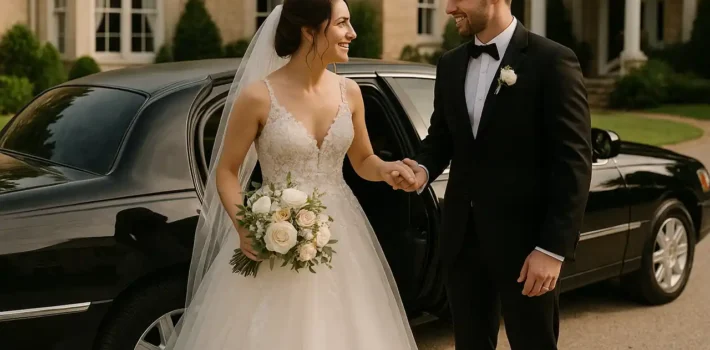
Wedding transportation should certainly feel special. The few quiet minutes a couple spends together between the ceremony and reception can become one of the rare private moments of an otherwise busy day. Keeping the wedding party together can add to the celebration, and arriving in a well-presented vehicle can complement the atmosphere couples have worked hard to create.
But the experience works best when strong logistics support it.
The right wedding transportation plan accounts for passengers, vehicles, timing, traffic, venues, accessibility, photography, weather, and the unexpected changes that naturally happen during a wedding.
NJ Luxury Rides provides wedding transportation in New Jersey for couples planning celebrations throughout Monmouth County, Ocean County, the Jersey Shore, and surrounding areas. From private transportation for the couple to larger vehicles for wedding parties and coordinated multi-stop itineraries, the goal should always remain the same: create a transportation plan that fits the wedding day rather than forcing the wedding day around the transportation.
The Role of Luxury Transportation For Your Wedding Day