
Group Transportation Planning for Large Events: A Complete Coordination Guide
Why Group Transportation Requires a Different Planning Framework
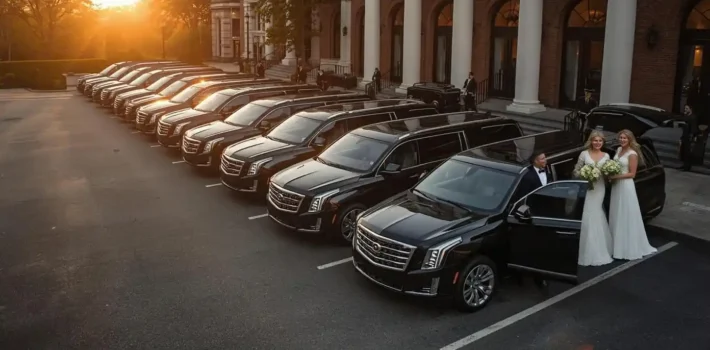
Large events introduce a category of complexity that individual travel never exposes. Whether the task is coordinating wedding guests across Monmouth County shore venues, transporting corporate attendees to a Newark conference center, or moving groups toward MetLife Stadium in East Rutherford, the challenge lies in synchronization rather than distance. Group transportation does not simply scale up from individual travel. It requires a structural approach to timing, vehicle deployment, and communication that is absent from standard trip planning entirely.
The scale of this challenge in New Jersey is significant. According to The Wedding Report’s 2025 New Jersey Wedding Market Statistics, New Jersey hosted 49,796 weddings in 2025, with an average guest count of 163 to 173 people per event, the second highest average guest count in the country. At that scale, guest transportation is not a secondary logistical detail. It is a primary operational challenge that, when handled without structure, becomes the most visible failure point of the entire event.
This guide covers the full coordination framework for large event group transportation in New Jersey, from initial vehicle planning through post-event dispersal, with specific attention to the venues, routes, and traffic patterns that shape how these events actually operate on the ground.
Why Group Transportation Fails Without Proper Coordination
Group transportation commonly fails not because of dramatic incidents but because small timing errors compound across multiple passengers and vehicles in ways that individual travel never produces. A single vehicle running five minutes late affects one passenger. The same five-minute delay in a multi-vehicle wedding shuttle operation can delay ceremony start times, disrupt photography schedules, and create a ripple effect that compresses every subsequent event phase.
The compounding failure pattern follows a consistent sequence. Staggered arrivals delay ceremony starts or keynote speeches because the venue cannot begin until a minimum threshold of guests is seated. Parking limitations at shore venues or urban event halls create unloading bottlenecks that slow vehicle throughput. Confusion at pickup points, particularly in hotels with multiple entrances or event facilities with multiple lobby levels, results in missed departures that require vehicles to circle or hold, creating congestion at the very point where flow should be smoothest. When several vehicles operate without centralized oversight, minor delays cascade into schedule disruptions that affect the entire event timeline.
The solution is not simply booking more vehicles or padding departure times. It is building a coordination structure before the event that eliminates the conditions under which small errors become large problems.
Defining Group Size and Vehicle Needs Early
Accurate passenger count forms the foundation of every subsequent planning decision. Underestimating headcount forces last-minute vehicle additions at premium rates, while overestimating creates unnecessary cost and idle capacity. Neither outcome serves the event or the budget.
| Group Size | Recommended Vehicle Type | Capacity | Best Use Case |
|---|---|---|---|
| 1 to 3 passengers | Black car sedan | Up to 3 passengers | VIP arrivals, bride and groom, executive transfers |
| 4 to 6 passengers | SUV or luxury van | Up to 6 passengers | Bridal party, small corporate groups, family transfers |
| 7 to 14 passengers | Mercedes Sprinter van | Up to 14 passengers | Guest shuttles, corporate team transfers, wedding party groups |
| 15 or more passengers | Multiple vehicles or charter coach | Varies by configuration | Large wedding guest shuttles, stadium groups, conference transfers |
Capacity planning must extend beyond headcount alone. Luggage, presentation equipment, floral arrangements, or wedding décor that occupies additional space reduces effective passenger capacity per vehicle and must be accounted for in the initial count. Accessibility requirements for elderly guests or passengers with mobility accommodations require specific vehicle selection and should be identified during the initial planning conversation, not discovered on the event day when alternative arrangements are no longer possible.
Clear numbers allow scheduling precision. Vehicles that are sized correctly for the group do not require last-minute substitutions, and drivers who know the exact passenger count can manage boarding efficiently without repeated headcounts or confusion about whether the vehicle is full.
Coordinating Multiple Vehicles for the Same Event
Multi-vehicle coordination requires defined roles and a communication structure that treats the fleet as a single operating unit rather than a collection of independent drivers.
A lead vehicle sets the arrival timing and pace for the sequence, particularly for weddings or executive groups where the order of arrival is meaningful. The lead vehicle’s driver serves as the primary contact for the event coordinator and communicates arrival status in advance so venue staff can prepare for each incoming group. Staggered departures prevent driveway congestion at tight venue entrances, which is a specific concern at Monmouth County estate properties and shore venues where single-lane driveways cannot accommodate multiple vehicles simultaneously.
Communication between drivers ensures spacing consistency and route alignment, particularly when navigating highways like the Garden State Parkway or Route 18 toward shore venues, where traffic behavior can change between the first and last vehicle’s departure. A driver who left the hotel 20 minutes before the last vehicle departed may have experienced different conditions than the driver who departed after the bulk of Saturday beach traffic had built on Route 35 or Ocean Avenue.
Central dispatch oversight provides real-time coordination so that vehicles operate as a synchronized unit. When a passenger is late to a pickup point, or when a venue’s driveway becomes unexpectedly congested, a dispatcher who has visibility across the entire fleet can make routing and timing adjustments that individual drivers cannot make independently without creating gaps in the overall coordination.
NJ Traffic Patterns That Affect Event Transportation
New Jersey’s road network carries predictable congestion patterns that interact directly with event transportation timing, and understanding those patterns before building the event schedule prevents the most common timing failures.
| Route / Corridor | Events Most Affected | Peak Congestion Window | Planning Response |
|---|---|---|---|
| Garden State Parkway (southbound, Shore exits) | Shore wedding guest shuttles, summer events | Friday afternoon and Saturday morning, Memorial Day through Labor Day | Depart before 11 AM or after 7 PM on summer Saturdays; add 30 to 45 minute buffer midday |
| Route 18 / Route 35 (Monmouth and Ocean County) | Shore venue transfers, hotel-to-venue shuttles | Saturday midday through early evening in summer | Route selection based on event venue; Route 18 faster for inland venues; Route 35 slower near beach towns |
| NJ Turnpike / I-78 (toward Newark and Jersey City) | Corporate conference transfers, airport connections | Weekday 7 to 10 AM and 4 to 7 PM | Schedule conference arrivals before 7:30 AM or after 10 AM; return departures before 3:30 PM or after 7 PM |
| Route 3 and Lincoln Tunnel approach (toward Manhattan) | Manhattan event transfers, stadium access from NJ | Weekday 7 to 10 AM inbound; 4 to 7 PM outbound; post-event dispersal from MSG | Build 45-minute tunnel buffer during peak; confirm event calendar before evening trips |
| NJ Route 3 (toward MetLife Stadium, East Rutherford) | Giants, Jets, concerts, FIFA World Cup 2026 matches | 90 minutes before and 60 minutes after all events with attendance above 50,000 | Depart at least 2 hours before event start; plan return departure 20 minutes after event ends to allow primary dispersal |
MetLife Stadium in East Rutherford deserves specific attention for group transportation planners. The stadium holds 82,500 people and has hosted more than 500 major events since opening in 2010, including Super Bowl XLVIII and multiple Copa América matches. For the 2026 FIFA World Cup, MetLife is scheduled to host eight matches including the final, which is expected to draw a global television audience in the billions. NJ Route 3 serves as the primary artery for eastbound and westbound access to the stadium from both New York City and Newark, and it becomes severely congested in the 90 minutes surrounding any event with attendance above 50,000. Groups traveling from Monmouth County to MetLife via the Garden State Parkway and Route 3 should plan for a minimum 2-hour pre-event departure from origin, with return timing planned around a 15 to 20 minute post-event hold to allow the initial dispersal wave to clear.
Timeline Mapping for Large Event Days
Timeline mapping creates the operational structure across phases of an event day and is the single planning step that most consistently separates smooth group transportation from reactive problem management.
Pre-event arrivals must account for traffic buffers that reflect the specific route, day of week, and season. A Saturday afternoon wedding in a Monmouth County shore town during July requires a materially different departure buffer than the same trip in October. Shore traffic on Route 35 during summer weekend afternoons can add 20 to 40 minutes to routes that would take 10 minutes in October. Building that buffer into the timeline before the schedule is finalized prevents the compressed arrival scenarios that force vehicles to rush and guests to board hurriedly.
Ceremony or main event start times require vehicles to arrive 20 to 30 minutes early to absorb the variability that is always present in real operating conditions. A shuttle scheduled to arrive at the ceremony venue at exactly the moment guests need to be seated has no margin for a traffic delay, a guest who is five minutes late to the pickup point, or a brief driveway congestion event. An arrival 25 minutes early converts those variables from potential failures into absorbed delays.
Intermission transfers during conferences demand precise staging. When a keynote session breaks and 200 attendees need to move to a second venue for lunch, vehicles that are staged at the venue before the break ends allow the movement to begin immediately. Vehicles that are summoned at the moment of the break create a 15 to 20 minute wait that erodes the schedule for the afternoon sessions.
Post-event exit flow planning is the phase most frequently underplanned and most visibly disruptive when it fails. Simultaneous vehicle crowding at venue exits, particularly at shore properties with limited egress roads or urban venues with restricted curb access, creates congestion that delays every departure. A structured dispersal sequence, with vehicles staged in groups and loaded in a defined order, reduces total exit time significantly compared to unmanaged simultaneous departure.
Managing Hotel-to-Venue Transportation
Hotel-to-venue transport is one of the most common large-event scenarios in New Jersey and one of the most frequently underestimated in its logistical complexity.
Wedding guest shuttles often move between shore hotels and waterfront venues where parking remains limited or entirely unavailable for guests. Shore venues along the Barnegat Bay, in Asbury Park, and across the broader Monmouth County coastline frequently have parking capacities well below their guest capacity, making shuttle service from nearby hotels a practical necessity rather than a convenience. Coordinating those shuttles requires knowing the hotel pickup location precisely (lobby entrance vs. parking lot vs. porte-cochere), the guest manifest per shuttle, and the timing of successive runs if the volume requires multiple trips.
Corporate conferences in Newark or Jersey City require timed departures to avoid morning congestion along I-78 or the NJ Turnpike. A conference session starting at 9 AM requires hotel pickup no later than 7:30 AM for Newark destinations under normal weekday conditions, and 7 AM during peak season. Departure times communicated the evening before through a clear hotel instruction sheet, rather than announced the morning of via a lobby sign, produce materially higher on-time departure rates.
Stadium transfers to MetLife or Prudential Center must account for entry restrictions and heavy pre-event traffic. Vehicles that arrive at MetLife in the 30 minutes immediately before a sold-out event encounter a combination of parking lot congestion, pedestrian crossings, and police traffic control that can extend the final approach mile to 20 or 30 minutes. Arriving 90 minutes before the event start and staging in a designated area outside the primary congestion zone allows groups to walk to the venue without vehicle exposure to the worst of the pre-event traffic.
Clear meeting instructions within hotel lobbies reduce confusion and improve departure efficiency more than any other single communication step. Guests who know exactly where to be, at what time, and what the vehicle looks like board efficiently. Guests who are looking for a shuttle in a hotel lobby without signage or a contact person create the kind of dispersed confusion that delays the entire group’s departure.
Venue-Specific Logistics Planning
Every venue carries its own logistical rules, and those rules shape how vehicles must be positioned, how arrivals must be sequenced, and how much coordination with venue staff is required before the event day.
Some estates in Monmouth County restrict driveway access to a single entry point, requiring staggered arrivals that are spaced by three to five minutes to prevent vehicles from queuing on the public road outside the property. Urban venues in Newark or Jersey City may enforce designated drop-off zones controlled by police traffic management, with vehicles that attempt to stop outside those zones redirected or ticketed. Security checkpoints at corporate events require credential verification before entry, adding a variable that must be built into arrival timing rather than discovered on arrival.
Coordinating directly with venue staff before the event eliminates the most common positioning errors. A venue coordinator who knows that four vehicles will be arriving in a staggered sequence beginning at 4:45 PM can have the driveway clear and the receiving area staged. The same venue coordinator who learns about the vehicle sequence at 4:50 PM on the event day is managing a situation rather than a plan.
Handling Large Exits After Events End
Post-event dispersal presents the highest stress window in any large event transportation plan. Crowd surges spill into parking lots and surrounding roads simultaneously, and vehicles that are not pre-positioned or pre-staged are competing with the same congestion they are trying to move guests through.
Designated pickup points, confirmed with guests before the event ends rather than announced at the conclusion, prevent vehicles from idling in restricted areas while guests search for the pickup location. A brief announcement during the event’s final phase, directing guests to a specific marked staging area, reduces the post-event coordination time significantly.
Staggered loading allows groups to board systematically instead of rushing simultaneously. When multiple vehicles are staged at the same pickup area, assigning specific vehicles to specific guest groups by table number, room number, or destination hotel eliminates the spontaneous crowding that occurs when guests choose their own vehicle without assignment.
Traffic dispersal strategy may include a deliberate hold of 10 to 15 minutes after the event formally concludes, particularly after stadium events where outbound traffic on Route 3 or the Garden State Parkway can stall for extended periods. Guests who board vehicles and wait comfortably in staged parking while the initial surge dissipates reach their destinations faster than vehicles that enter the dispersal congestion at peak and sit in standstill traffic for 30 to 45 minutes on a road that would take five minutes at normal flow.
Communication Strategy for Group Coordination
Clear communication anchors group movement and is the element that fails most quietly when it is absent. Groups that do not know where to be, when to be there, and who to contact when something is unclear default to improvisation, and improvised group transportation is the condition from which cascading delays most reliably emerge.
| Communication Element | What It Prevents | When It Should Be Delivered |
|---|---|---|
| Designated central contact person | Conflicting instructions reaching drivers from multiple sources | Identified before the event; communicated to all drivers and the venue coordinator |
| Written pickup instructions for guests | Lobby confusion, missed departures, guests waiting at wrong entrances | Distributed the evening before the event or included in the event program |
| Real-time driver updates | Guest uncertainty when traffic causes delay; panic when a vehicle is running five minutes late | Sent proactively as conditions develop, not reactively after delay has occurred |
| Backup meeting points | Complete pickup failure if a primary entrance becomes inaccessible due to congestion or venue change | Identified during planning; communicated to the central contact and venue staff |
| Visible vehicle identification | Guests boarding incorrect vehicles; driver confusion about which passengers belong to which vehicle | Confirmed before departure; signage or a designated contact meets each vehicle |
Safety Considerations for Large Group Transport
Passenger accountability ensures no guest is left behind during staggered departures, which is the most common safety gap in large group operations. A formal headcount or manifest check before each vehicle departs, rather than a visual scan by the driver, provides a verifiable record that the vehicle carried its assigned passengers. In a multi-vehicle operation where guests may have boarded a different vehicle from their assignment, the manifest check catches the discrepancy before the event is underway.
Seat belt compliance remains mandatory on all highway segments, and it should be communicated explicitly to passengers rather than assumed. Groups traveling between shore venues and hotels on the Garden State Parkway are on a high-speed corridor, and the celebratory nature of wedding and event transportation does not reduce the legal or physical requirement for restraints.
Alcohol-related safety becomes a distinct planning consideration for weddings and celebratory events. Return transportation for guests who have consumed alcohol at a reception or event is not simply a convenience. It is a responsibility that the event host assumes when serving alcohol, and transportation planning that provides a reliable return option removes the conditions under which guests make their own alternative arrangements. Clear communication about the return shuttle timing and pickup location, delivered before the event ends, produces higher uptake than announcements made at the conclusion of the reception when guests are already dispersing.
Late-night travel requires route awareness to avoid poorly lit or congested corridors, and fatigue management for drivers on extended event assignments. A professional car service assigns drivers with adequate rest before long event days and rotates assignments on multi-vehicle operations so no single driver is managing multiple back-to-back transfers without adequate breaks.
Common Mistakes in Group Transportation Planning
| Common Mistake | Consequence | Prevention |
|---|---|---|
| Underestimating traffic during peak season | Late arrivals at ceremony or keynote; compressed photography windows | Add 30 to 45 minutes to all summer weekend shore routes; check NJDOT alerts morning of event |
| Booking too few vehicles | Overcrowding or delayed second trips that compress the event schedule | Confirm headcount with a 10 percent buffer above the confirmed RSVPs; plan for late additions |
| Ignoring return timing | Guests stranded at venue; extended waits after events conclude | Plan return logistics at the same detail level as inbound; confirm last departure time with venue |
| Last-minute itinerary changes without notifying dispatch | Vehicles positioned incorrectly; timing gaps that cascade across the fleet | Establish a cutoff time for itinerary changes (24 hours prior); communicate all changes through a single contact |
| No designated guest contact person at pickup | Guests scattered across hotel lobby; drivers waiting without confirmation of full boarding | Assign an event contact or usher to meet vehicles at each pickup point; provide their phone number to the lead driver |
| Assuming app-based ride-hailing will cover overflow | Surge pricing during peak event hours; driver unavailability in suburban or shore locations | Book all required vehicles in advance; do not rely on on-demand services as a backup for confirmed guest groups |
The ride-hailing backup assumption deserves specific attention for New Jersey shore events. App-based services perform well in densely populated urban areas with high driver availability. In shore towns during peak wedding season, driver availability drops significantly at the exact moments when demand is highest: Saturday evening post-reception dispersal, late-night hotel returns, and Sunday morning checkout transfers. Groups that planned on supplementing a pre-arranged fleet with on-demand vehicles during those windows frequently find that surge pricing has made the option prohibitively expensive and that available drivers are not familiar with the local venue access roads.
Why Professional Coordination Reduces Event Stress
Professional group transportation coordination introduces dispatcher oversight, experienced chauffeurs, and contingency planning that transforms transportation from a variable the event host manages into a background process that operates predictably without their attention.
Venue familiarity eliminates guesswork around access rules. A transportation provider with prior experience at a specific Monmouth County estate or shore venue knows which driveway handles inbound vehicles, where the staging area is for waiting vehicles between shuttle runs, and which entrance is accessible for guests with mobility limitations. That knowledge is not available through a navigation app and is not communicated in a venue’s public-facing information. It comes from operational experience at that location.
Multi-vehicle scheduling tools synchronize arrival and departure times across the fleet and provide real-time visibility into each vehicle’s position and status. When a vehicle is delayed by unexpected congestion on the Garden State Parkway, the dispatcher sees the delay before the event coordinator does and can communicate revised timing proactively rather than reactively. Instead of managing logistics personally during the event, hosts and planners focus on the event itself while transportation operates predictably in the background.
Choosing the Right Transportation Partner for Large Events
Selecting the right partner for large event group transportation requires evaluating prior experience with similar-scale events, fleet flexibility across vehicle types, and communication discipline before, during, and after the event day.
The practical evaluation questions are straightforward. Ask how the provider handles multi-vehicle coordination and what their communication structure looks like between drivers and dispatch. Ask how they manage post-event dispersal at high-volume venues and whether they have operated at the specific venue or venue type involved. Ask what their process is when a guest is late to a pickup and the vehicle needs to decide whether to hold or depart on schedule.
Providers who can answer those questions with operational specificity, rather than general assurances, demonstrate the kind of experience that translates to reliable performance on the event day. Providers who offer the lowest rate without evidence of coordination infrastructure are priced correctly for the level of service they will deliver.
NJ Luxury Rides coordinates group transportation for weddings, corporate events, stadium transfers, and multi-vehicle event operations across Monmouth County, Ocean County, and the New York metro area. For wedding-specific coordination frameworks, the guide on wedding transportation services outlines structured approaches to ceremony and reception logistics, including bridal party sequencing and guest shuttle planning. Additional planning depth on timeline mapping and seasonal traffic considerations for New Jersey weddings is covered in the guide on how to plan transportation for weddings in New Jersey.
Concert and Sporting Event Transportation Mistakes to Avoid
Large concerts and sporting events create transportation challenges that look manageable on paper but become chaotic in execution. Whether attending Read More
How New Jersey Professionals Plan Stress-Free Transportation for Major Events
Major events rarely fail because of poor planning. They fail because of overlooked details. Transportation often sits at the top of that list. In New Jersey, where spring brings Read More