
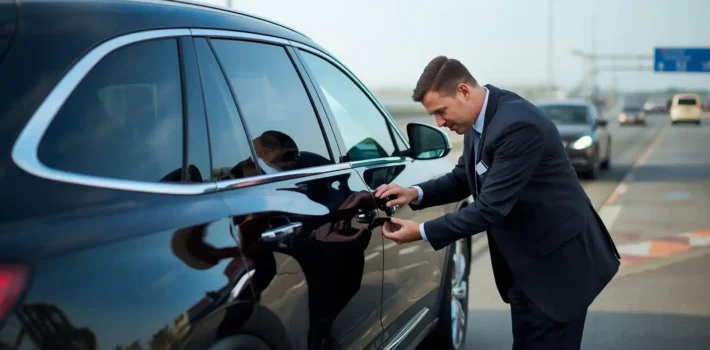
Passenger safety stands at the center of professional transportation. Every system, procedure, and compliance standard exists to reduce risk before it becomes visible to the client. Unlike informal travel arrangements, professional car services operate under a duty of care that extends beyond simply driving from one point to another. Whether transporting executives from Newark to JFK, a 35 to 50 mile journey depending on route, or navigating peak congestion on the New Jersey Turnpike, safety depends on layered systems working together consistently.
Why passenger safety is the foundation of professional transportation
Professional transportation carries higher exposure than personal travel because it involves paying passengers, commercial vehicles, and public roadway interaction under regulatory oversight. Duty of care requires providers to anticipate mechanical, human, and environmental risks before they affect passengers. Routes such as I-78 into Newark Liberty, Garden State Parkway corridors through Monmouth County, or cross-Hudson travel toward JFK via the Belt Parkway expose vehicles to congestion, sudden braking conditions, and heavy merging traffic, making structured safety systems essential rather than optional.
Driver screening and qualification standards
Safety begins with who sits behind the wheel. Professional services conduct criminal background checks, verify driving history for violations or suspensions, and apply disqualification policies for unsafe patterns. Driving record evaluations assess accident history, moving violations, and license status, while ongoing monitoring ensures compliance does not lapse over time. Unlike informal driving arrangements, professional operators maintain documented qualification standards that tie eligibility directly to continued employment.
Chauffeur training and defensive driving practices
Defensive driving forms the core of chauffeur safety training. Chauffeurs learn hazard anticipation techniques such as maintaining extended following distances on high-speed corridors like the NJ Turnpike and adjusting lane positioning during heavy merge zones near Exit 13A toward Newark Airport. Urban traffic awareness becomes critical in Manhattan-bound travel where pedestrian density and signal timing increase unpredictability. Emergency response basics prepare chauffeurs to manage tire blowouts, sudden braking events, or evasive maneuvers without compromising passenger stability.
Vehicle inspection and maintenance protocols
Mechanical safety relies on routine inspections and preventive maintenance schedules that exceed personal vehicle norms. Brake systems, suspension components, tire tread depth, and alignment receive scheduled evaluation because highway speeds between central New Jersey and JFK can exceed 65 mph for sustained distances. Pre-trip reviews confirm fluid levels, tire pressure, signal functionality, and structural integrity before every departure. These layered checks reduce breakdown risk along high-traffic arteries such as Route 1 & 9 or the Van Wyck Expressway.
Commercial insurance coverage and liability protection
Commercial coverage provides structured protection that aligns with passenger exposure. Liability limits for professional services typically exceed personal auto policies because risk involves paying passengers and third parties. Passenger coverage applies from pickup through drop-off, and accident response structures define clear reporting and claims processes. For deeper understanding of coverage layers and regulatory differences, see Commercial Insurance Explained for Luxury Car Services, which outlines how policy structures support safety accountability.
Real-time route planning to reduce risk exposure
Operational safety depends heavily on route planning that accounts for congestion patterns, construction zones, and weather disruptions. Travel from Princeton to Newark Liberty averages 35 to 45 miles depending on route selection, but heavy traffic on I-95 or I-295 can add 20 minutes without buffer planning. Professional dispatch teams monitor traffic data and adjust routes to avoid stalled segments near Exit 14 toward the airport or congestion on the Holland Tunnel approaches. Alternate route preparation reduces exposure to unpredictable slowdowns and sudden braking chains.
Airport and event safety coordination
Airports represent high-risk environments due to congestion and enforcement patterns. Newark Liberty’s Terminal C arrivals experience dense curbside flow during evening peaks, while JFK terminal loops require precise entry timing to avoid forced re-circulation. Staging areas allow chauffeurs to wait legally without blocking traffic. During corporate events at venues such as the Javits Center or large conference hotels in Jersey City, coordination with security and traffic control ensures safe loading zones and reduces pedestrian interaction risk.
In-vehicle safety standards for passengers
Passenger safety continues inside the vehicle. Seat belt compliance remains mandatory, and chauffeurs verify functionality during inspections. Child safety seat policies follow state requirements and must meet age and weight guidelines. Interiors remain hazard-free with secured floor mats and stable climate control systems that prevent windshield fogging during temperature shifts. A clean cabin reduces distraction and promotes stable travel conditions.
How professional services handle emergencies
Preparedness defines emergency response. In case of mechanical breakdown along corridors like the Garden State Parkway, chauffeurs follow structured roadside safety procedures including hazard signaling and secure vehicle positioning. Accident protocols require immediate dispatch notification, passenger status assessment, and coordination with emergency responders. Backup vehicle dispatch systems minimize disruption while maintaining safety standards. Clear communication prevents panic and maintains control during unexpected events.
Safety differences between professional car services and rideshare
Professional car services operate under structured oversight that integrates insurance, inspections, and chauffeur qualification tracking. Rideshare vehicles typically fall under personal classification models with conditional coverage phases and limited centralized monitoring. Accountability chains in professional services tie responsibility directly to the operating company, while rideshare models distribute liability across platform and driver structures, creating variation in enforcement and compliance rigor.
Safety expectations for corporate and executive clients
Corporate clients evaluate safety as part of vendor risk management. Travel between Newark, JFK, and LaGuardia often involves tight schedules where congestion risk and airport timing require structured buffer planning. Documentation readiness, inspection records, and insurance verification become part of corporate vetting processes. Audit preparedness reflects operational maturity and long-term compliance discipline.
How passengers can evaluate a car service’s safety standards
Passengers can evaluate safety by asking about inspection frequency, insurance coverage limits, chauffeur screening procedures, and route planning methods. Visible indicators include well-maintained vehicles, professional driver conduct, and clear communication protocols. Red flags include vague answers, inconsistent vehicle condition, or lack of documentation transparency. Services offering structured Black Car Service programs typically integrate these standards into daily operations.
Why consistent safety systems build long-term trust
Consistent safety systems build reputation over time. Reduced breakdown rates, predictable arrival times, and disciplined response to incidents reinforce credibility. Clients return not because safety is advertised, but because it becomes evident through execution. Professional credibility grows from prevention systems that operate quietly and reliably beneath the surface of every trip.