
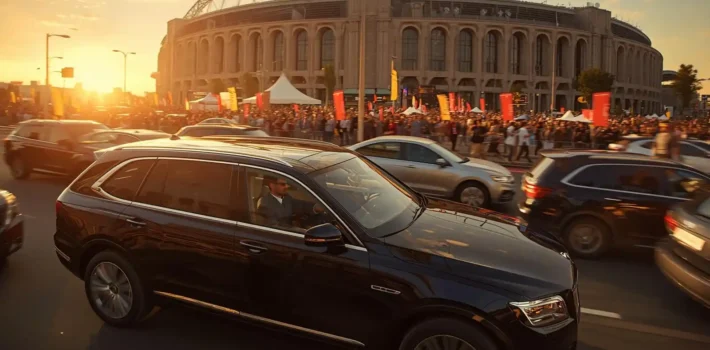
Large concerts and sporting events create transportation challenges that look manageable on paper but become chaotic in execution. Whether attending a sold-out show at MetLife Stadium in East Rutherford, a game at Prudential Center in Newark, or a major concert at Madison Square Garden in Manhattan, traffic flow shifts dramatically within tight time windows. Thousands of vehicles converge within the same 60 to 90 minute arrival period, and even minor miscalculations compound quickly. Planning transportation correctly prevents stress, delays, and post-event gridlock that can extend well beyond the final encore or whistle.
Why event transportation fails more often than expected
Event transportation fails because crowd behavior compresses timelines. Fans tend to arrive within a narrow pre-event window, which overwhelms parking entrances and access roads simultaneously. At venues like MetLife Stadium, Route 3 and the New Jersey Turnpike often slow significantly two hours before kickoff, while pedestrian flow intensifies near parking lots and stadium gates. Parking confusion, rideshare congestion, and staggered group arrivals create friction that most attendees underestimate until they experience it firsthand.
Underestimating event traffic timing
The most common mistake involves underestimating how early congestion begins. Pre-event traffic around MetLife can start building 90 minutes before major NFL games, and summer concerts at PNC Bank Arts Center along the Garden State Parkway often slow Exit 116 well before showtime. NYC venues introduce additional bottlenecks as Midtown streets narrow under event volume near MSG or Barclays Center. Shore summer concerts in Asbury Park add beach traffic into the equation, creating layered congestion that extends beyond standard rush hour patterns.
Relying on last-minute transportation
Last-minute booking increases execution risk significantly. Driver availability tightens as demand surges, especially when multiple events occur simultaneously across NJ and NYC. Surge pricing escalates unpredictably on app-based platforms, and cancellation risk rises when drivers struggle to reach congested zones. Pickup confusion increases because drivers unfamiliar with venue staging areas may hesitate or reroute abruptly, adding unnecessary delay to already compressed timelines.
Ignoring venue-specific pickup and drop-off rules
Each venue operates under distinct access rules that change on event days. MetLife enforces designated drop-off loops that police redirect frequently depending on congestion. Prudential Center relies on coordinated curb access along Mulberry Street, which can close temporarily during heavy pedestrian movement. In Manhattan, MSG pickup zones shift due to NYPD traffic control and temporary no-standing enforcement. Ignoring these venue-specific rules results in forced rerouting, missed pickups, and unnecessary circulation through gridlocked streets.
Poor coordination for group arrivals
Group travel introduces its own complexity. Multiple vehicles arriving separately create staggered entry delays that fragment the experience. Ticket entry timing becomes uneven when part of the group waits for late arrivals. Clear meeting points inside and outside the venue prevent confusion, particularly in high-density pedestrian areas. Coordinated arrival windows ensure groups move through security and gates together rather than dispersing in crowded plazas.
Failing to plan exit strategy after the event
Post-event congestion often exceeds arrival congestion because thousands attempt to leave at once. Stadium parking lots empty gradually, but access roads like Route 120 near MetLife or Route 35 near Shore venues bottleneck quickly. Mass pedestrian flow blocks vehicle lanes, delaying access for rideshare and private vehicles. Pre-arranged pickup points away from primary gates reduce wait time and avoid extended idling within traffic clusters.
Choosing the wrong vehicle for the event size
Vehicle choice directly affects efficiency. Small sedans may struggle to accommodate tailgate supplies, folding chairs, or large groups attending games. Larger SUVs or executive vans handle group coordination better while maintaining comfort. VIP access points sometimes restrict vehicle size, so matching vehicle type to venue access rules prevents unnecessary maneuvering delays in tight drop-off loops.
Not accounting for alcohol consumption and safety
Concerts and sporting events frequently involve alcohol consumption, increasing safety responsibility. Designated driver assumptions often fail when plans shift or fatigue sets in after late-night events. Driving late after high-energy events increases risk due to reduced visibility and heavy outbound congestion. Professional transportation ensures responsible return planning, eliminating impaired driving concerns and post-event fatigue hazards.
Underestimating timing between venues
Many event days involve multi-stop plans such as pre-event dinners in Hoboken before a MetLife game or post-concert gatherings in Manhattan after an MSG show. Travel between Hoboken and East Rutherford via Route 3 can range from 20 to 45 minutes depending on timing. Manhattan dinner-to-arena transfers may take only minutes off-peak but expand significantly during event windows. Coordinated scheduling ensures transitions do not compress arrival timing unexpectedly.
Why professional chauffeurs manage event congestion better
Professional chauffeurs anticipate congestion patterns based on experience rather than reacting once traffic stalls. Familiarity with staging zones, alternate entry points, and venue staff coordination reduces idle time. Alternate route awareness through secondary highways or parallel streets helps avoid the heaviest congestion corridors. Crowd anticipation allows for smoother navigation through pedestrian-dense areas without abrupt braking or unsafe maneuvers.
Differences between professional car services and rideshare at events
Professional services operate under structured dispatch systems that track vehicle location and coordinate staging. Rideshare drivers often rely solely on app guidance, which may not reflect temporary closures or enforcement shifts. Cancellation risk rises when drivers face extended wait times. Accountability structures differ significantly, as professional services maintain direct responsibility for timing and execution.
How to build a reliable event transportation plan
Reliable planning begins with early booking, particularly for high-demand events during peak seasons. Timeline coordination should include arrival buffers of 30 to 60 minutes before event start. Clear pickup instructions prevent confusion in crowded areas. Backup strategy planning, including alternate pickup zones or staggered departure timing, protects against last-minute congestion surges. Structured Concert Transportation planning ensures coordination remains stable even when venue conditions shift.
Questions to ask before booking event transportation
Ask providers about prior experience at the specific venue. Confirm their exit strategy planning and familiarity with police traffic control patterns. Discuss group coordination capabilities and standby options for extended events. Services experienced in Group Transportation Planning for Large Events often demonstrate stronger logistical readiness and crowd navigation awareness.